Part A: Social Media Analytics
Theory and Knowledge Development
Marketing Objectives and Social Media
- Increase: awareness
- Influence: desire
- Encourage: trial
- Facilitate: purchase
- Cement: brand loyalty
- Recover: from service failures
Social Media Analytics Research
Social media research: the application of scientific marketing research principles to the collection and analysis of social media data such that valid and reliable results are produced.
To plan a social media marketing strategy that will meet objectives, it is important to understand the target audiences and their environment, including consumer personalities and past experiences, motives and fears, brand loyalties, and media usage.
Research can be used to make informed marketing decisions - market, competitive and consumer insights.
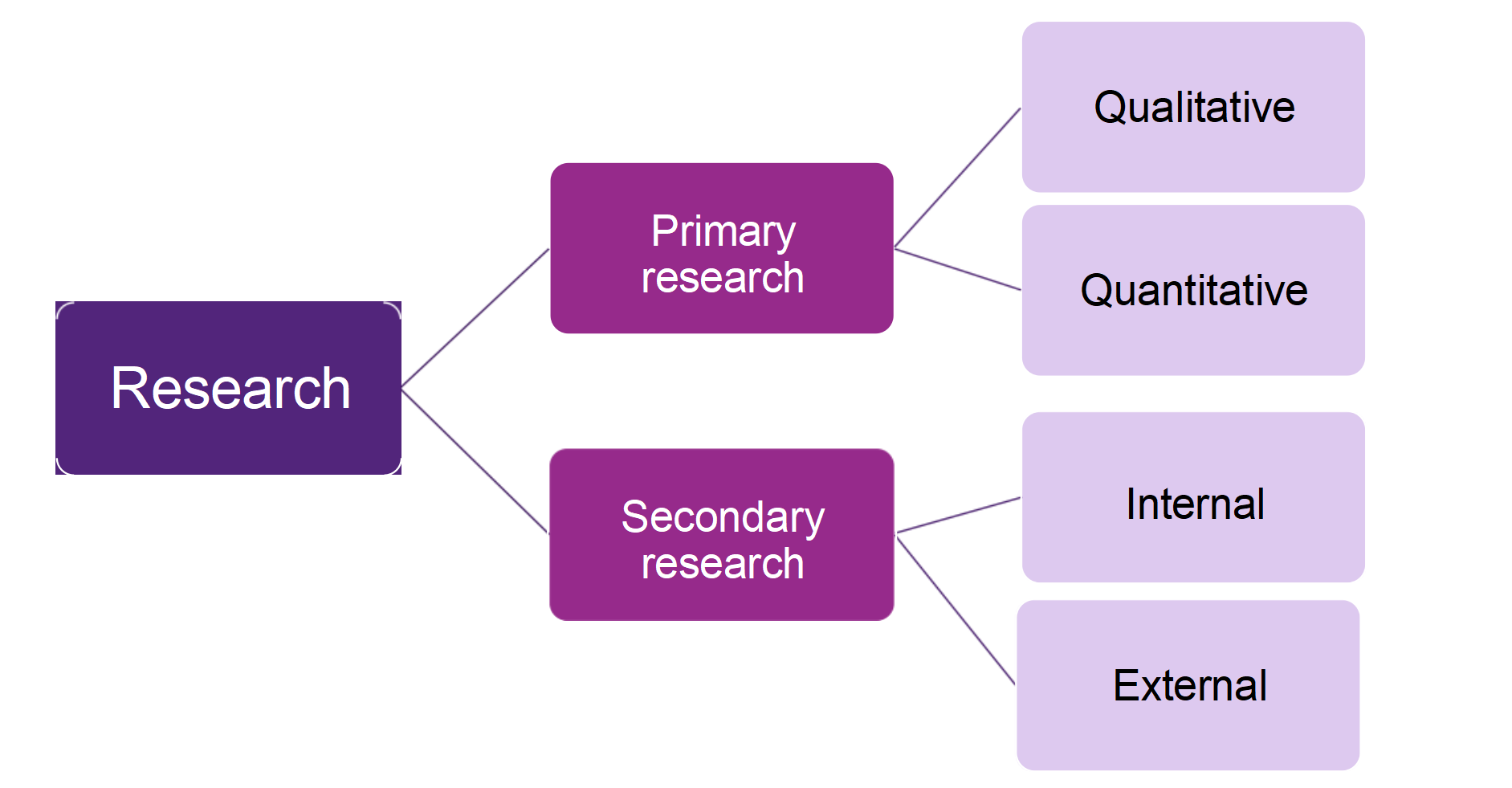
Research Types
- Primary research: Data collected for the research purposes at hand – e.g. qualitative methods such as observation, focus groups, and in-depth interviews; descriptive techniques such as surveys; or with experimental techniques such as simulations and test markets.
- Secondary research: Information already collected and available for use. It may be internal, published publicly, or available via syndicated sources – e.g. background on the market, industry, competitors, and the brand’s history.
- Social media research: Any form of research that uses data derived from social media sources – e.g. data mining of naturally occurring data across social media channels, ethnographic research (called netnography) and other qualitative methods.
Social Media Monitoring and Listening
Social monitoring Identification on a micro scale
- Collecting public mentions across social media (process of tracking mentions of specific words or phrases on social media sites.)
- Helps track social media metrics & success of marketing strategies
Aspects
- measurable metrics
- hashtag tracker
- gauge reputation
Social listening
- Occurs at a macro level
- Trying to understand online conversation (identifying and collecting information shared on social media sites, but for listening)
- Develop insights to improve future marketing strategies
Aspects
- sentiment analysis
- estimated reach
- context of discussion
Social Customer Care
Listening to social media conversations is a key activity for marketers involved in social CRM tactics – and can be vital for service recovery.
- 67% of social media users have used a company’s social media channels to reach customer support. Of those, 84% expected a response within the first 24 hours.
- Customers spend 20–40% more on companies that use social media to service customer care requests.
- 71% of customers who experience a quick and effective brand response to their support requests on social media are likely to recommend that brand to others, compared to 19% of those that don’t receive any response.
- Only 1 in 10 customer care requests made on social media get a response.
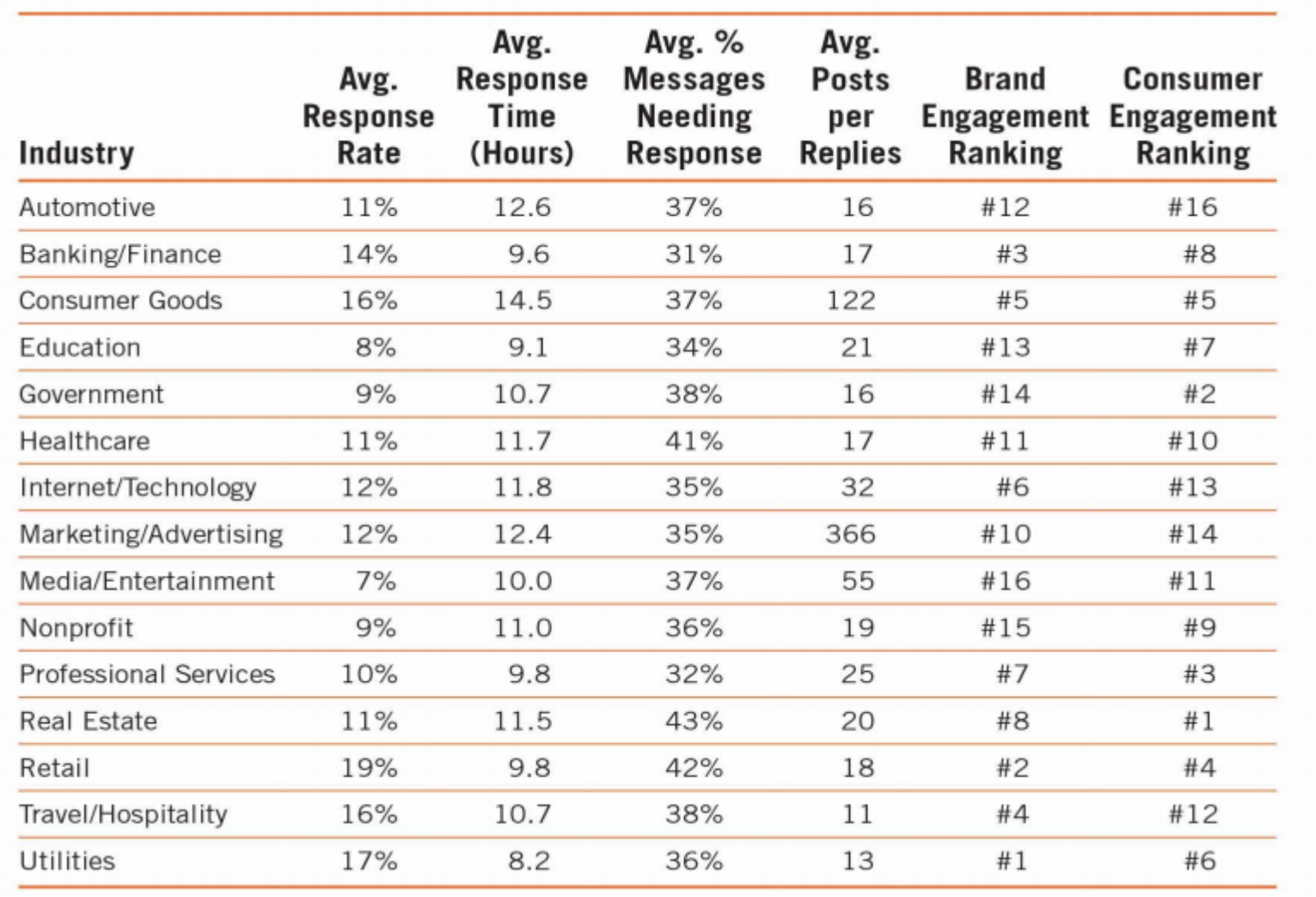
Results from study measuring which industries get the most customer service requests via social media, the % of those that were addressed, and the average response time.
Uses for Social Media in Research
- Brand monitoring
- Measuring campaign effectiveness
- Gathering customer insights
- Providing customer service
- Gathering ideas for future campaigns
- Gathering competitive intelligence
- Identifying ideas for new product development or product improvements
- Identifying risks that could lead to public relations crises
Social Media: The Research Process
Observational research: recording behaviour or the residual evidence of behaviour.
Research can collect data that is publicly available in the social media space; content shared across all four zones of social media:
- Conversations in social networks and forums
- Blog posts and comments
- Product reviews
- Photos shared in sites such as Instagram
- Videos shared on sites such as YouTube
- Social bookmarks and comments
- Microblog posts
An Overview of Social Monitoring and Listening
- Software or service systematically searches and scrapes data from social media channels.
- Data includes qualitative (e.g., verbatim comments) and quantitative data (e.g., source, volume, unit characteristics).
- Determining appropriate research design and setting research protocols ensures data collected are appropriate for research uses.
- Common applications include sentiment analysis and content analysis.
Social Media Monitoring
Monitoring explains what was said, when, by whom, and how many times. The process answers four basic questions:
- How many times was the search term found?
- When was the search term found?
- Where was the search term found?
- Who mentioned the search term?
Content of Collected Data
- Positive comments can turn into customer testimonials for use in retailing and promotions
- Comments about competitors serve as competitive intelligence
- Conversations among like-minded groups of friends and connections provide consumer insight that’s useful for targeting and positioning
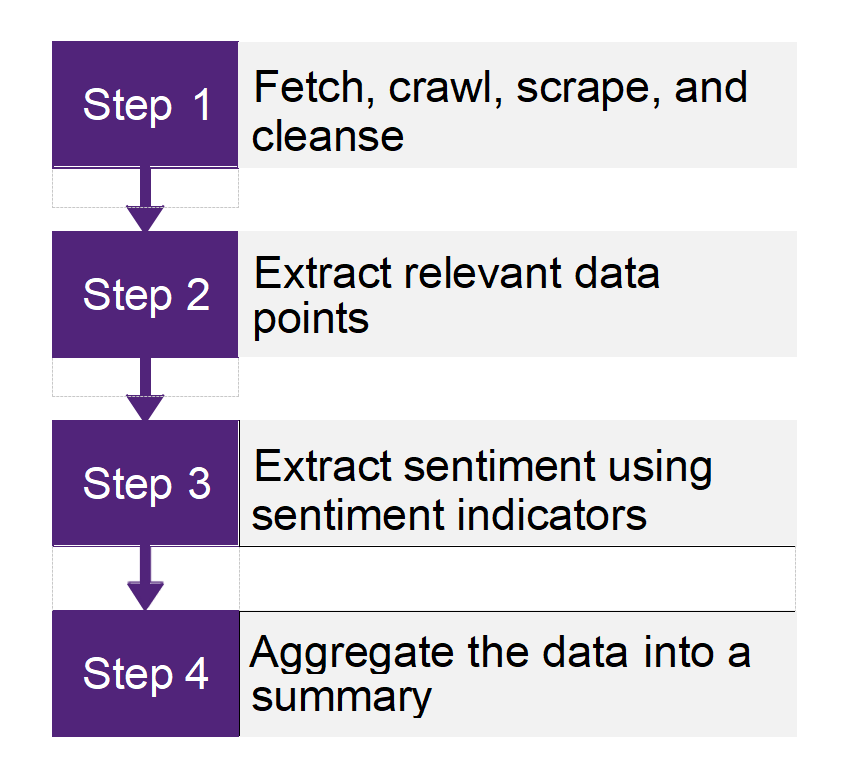
Sentiment Analysis (Text Mining)
Sentiment: how people think or feel about an object such as a brand or a political candidate (also known as opinion mining). Uses a bottom-up approach.
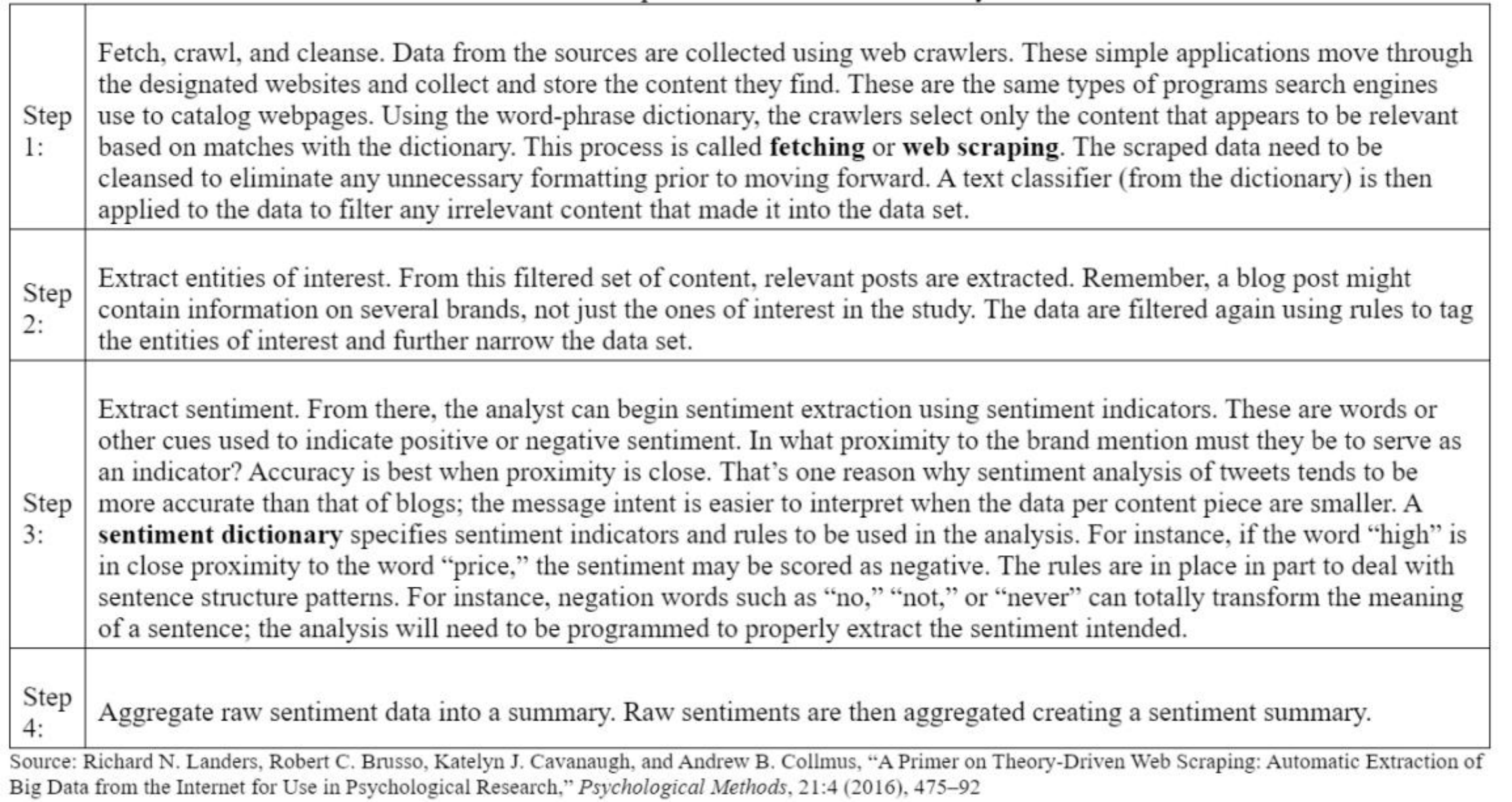
In social media, sentiment analysis looks at the content to determine the attitude of the writer; to determine whether the relevant conversations are positive or negative.
Sentiment dictionary: specification of sentiment indicators and rules for analysis.
Case Study: Volkswagen's #DieselGate Damages Brand
In 2015, the Environmental Protection Agency found that many Volkswagen cars were equipped with software that could falsely improve the performance of diesel engines on emissions tests. This cheating was subsequently acknowledged by Volkswagen.
In the first two weeks, more than 2 million tweets using the hashtag #Dieselgate were shared. Social listening and sentiment analysis are useful as an early warning detection system for potential crises, but they are also useful in gauging the extent of damage and response to corporate efforts to recover.
As #Dieselgate dominated the news landscape, researchers used social listening tactics to study the impact of the crisis on the brand.
The YouGov Brand Index of consumer perception found that Volkswagen’s score dropped:
- from 10 to -2 in the U.S.
- from 20 to -8.32 in Germany
Sentiment analysis of tweets related to Volkswagen before and after the news showed a swing in sentiment from +17% to -7%.
Fortunately for Volkswagen, the sentiment score began to slowly rise over time, illustrating that the company’s efforts to apologise to the public and make amends were influencing sentiment.
Challenges Associated with Sentiment Analysis
- Accuracy in gauging sentiment with automated tools. The sheer volume of conversation creates an information overload issue for most brands wanting to use social media monitoring and research.
- Cultural factors, linguistic nuances, and differing contexts all make it difficult to code text into negative, neutral, or positive categories.
- Defining the sentiment dictionary can also be a challenge, ultimately affecting whether the right words are extracted. Words can have many meanings.
- Accuracy in the categorical data; it’s difficult to gauge who is making comments (which segments they represent) in terms of demographic and geographic descriptors.
Content Analysis
Content analysis: identifying the presence of concepts and themes within qualitative data sets. The primary unit of analysis is the word. Uses a top-down approach.
Content analysis involves assigning codes to classify data; themes/comments are examined and interpreted.
Codes: labels that classify and assign meanings to pieces of information
For social media research, the researcher must ask:
“Which social media platforms and sites should be (and can be) included in data collection?”
Sampling Concepts
Sampling: the process of selecting specific cases from a sampling frame for inclusion in a study. When sampling in social media research, it is important to ensure the content is representative of the population.
- Population: The units of interest; the people or families to which we wish to generalise the study results.
In social media: the social communities to which the target audience belongs. - Sample: A subset of the population.
- Census: A sample of the whole population.
- Sample frame: An available list that approximates the population and from which we draw a sample to represent the population.
Research Errors and Biases
Every study has a certain amount of error that we cannot precisely specify; our goal as researchers is to minimise that error.
- Coverage error: Failure to cover population elements due to gap between the sampling frame and the population of interest; in social media, privacy settings limit access.
- Sampling error: When sample selection results in a sample that fails to accurately represent sampling frame.
- Echo effect: Duplication in conversation volume in social media spaces.
- Participation effect: High activity by only some participants inflates perception.
- Nonresponse bias: Units not included in sample may be significantly different from those included.
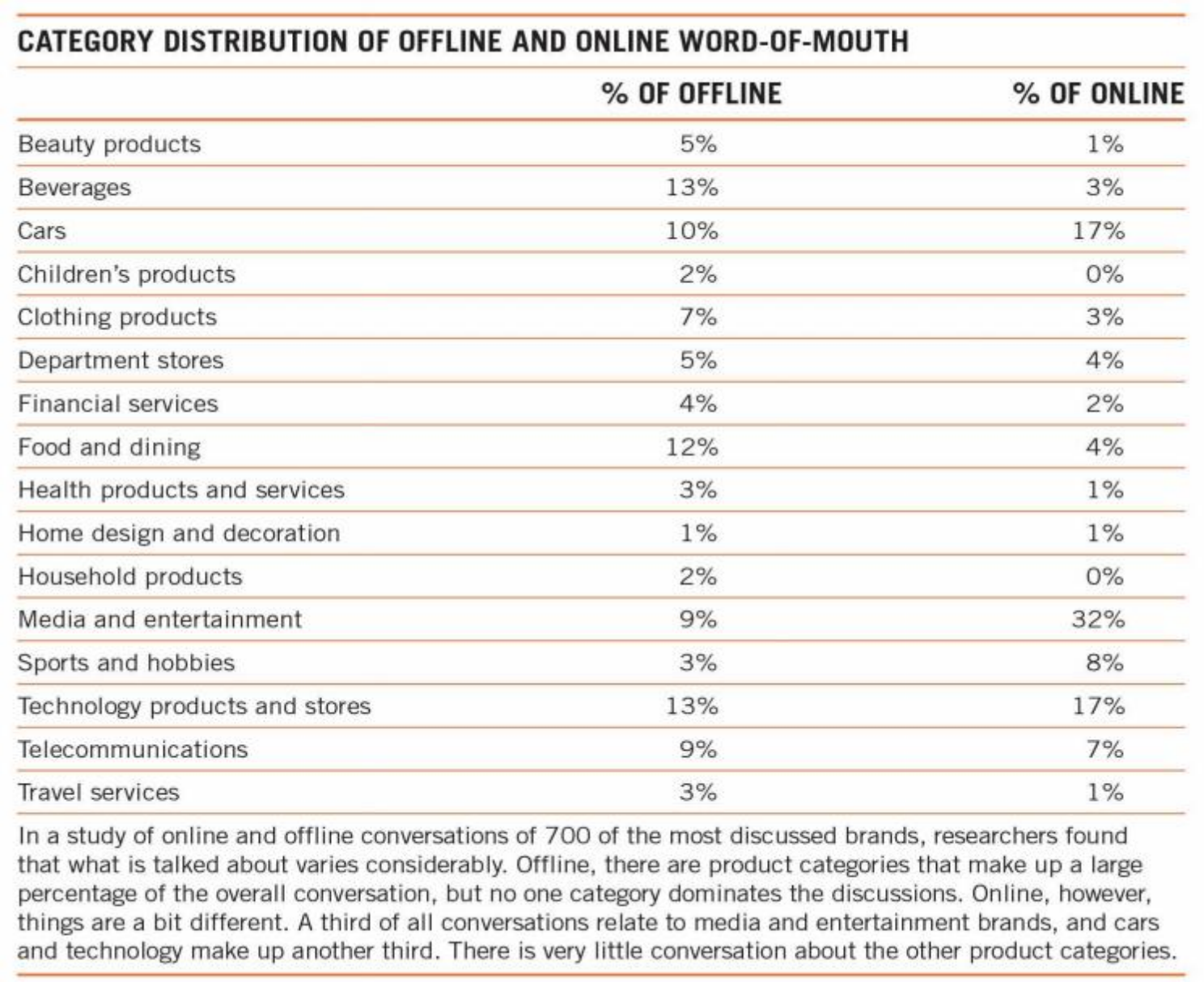
Sampling weights: Adjustment factors applied to adjust for differences in probability of selection between cases in a sample.
Is It Ethical To Mine Social Media Conversations?
The issue:
Traditionally, researchers conducting primary research with human subjects follow a policy of informed consent. But when scraping social channels for data, the data mined are residual traces of online behavior.
Result: People unwillingly and unknowingly may become subjects in a research study.
Example:
Researchers scraped public profile data from 70,000 users of online dating site OKCupid.
The data was published online including non-anonymized usernames, drug usage, and intimate sexual details.
The lead researcher defended the breach saying the data was already public.
Ethical Guidelines for Social Media Researchers
- If content has been posted to a truly public domain (i.e., there is no gate to viewing data such as registration), it can be used by the researcher.
- If content is posted in a “gated community” to be available to members only, researchers should announce their presence and request cooperation.
- Researchers should never pretend to be something or someone they are not when they interact in social communities.
- Assess whether the data to be collected will include personally identifiable and/or sensitive information. If they do, take steps to comply with relevant policies and protect the interests of the affected individuals.
- Processing of personally identifiable data should require informed consent, or at a minimum the implication of deemed consent.
- Prior to reporting and sharing of data, all information should be anonymised.
- Take steps to ensure no harm comes from researcher behavior or use of research results.
Social Listening Analysis
Social listening analysis: systems that enable real-time insights for strategic decision-making.
The analysis provides a social snapshot of the campaign, isolating social conversations to identify:
- Topics of interest
- Themes
- Advocates
- Specific social channels
This can be used to accurately analyse how a product, campaign, or services compare against the competition and industry.
Part B: Social Media Metrics
Theory and Knowledge Development
What Matters is Measured
What matters, first and foremost, are those metrics that align most closely with your social media marketing objectives.
The key is to figure out which metrics make the most sense for the given brand and campaign.
A common misconception about social media is that being active and posting updates will create hundreds of conversions.
Oftentimes, the true value of social media—like brand awareness—cannot be measured in dollars and cents.
The challenge is to identify the right measures to use!
Key Performance Indicators (KPIs)
Social media are meant to be about participation and relationships between brands and consumers.
But counting followers and fans, retweets, and blog comments is relevant only if those behaviors relate to the goals of the brand's social media activity.
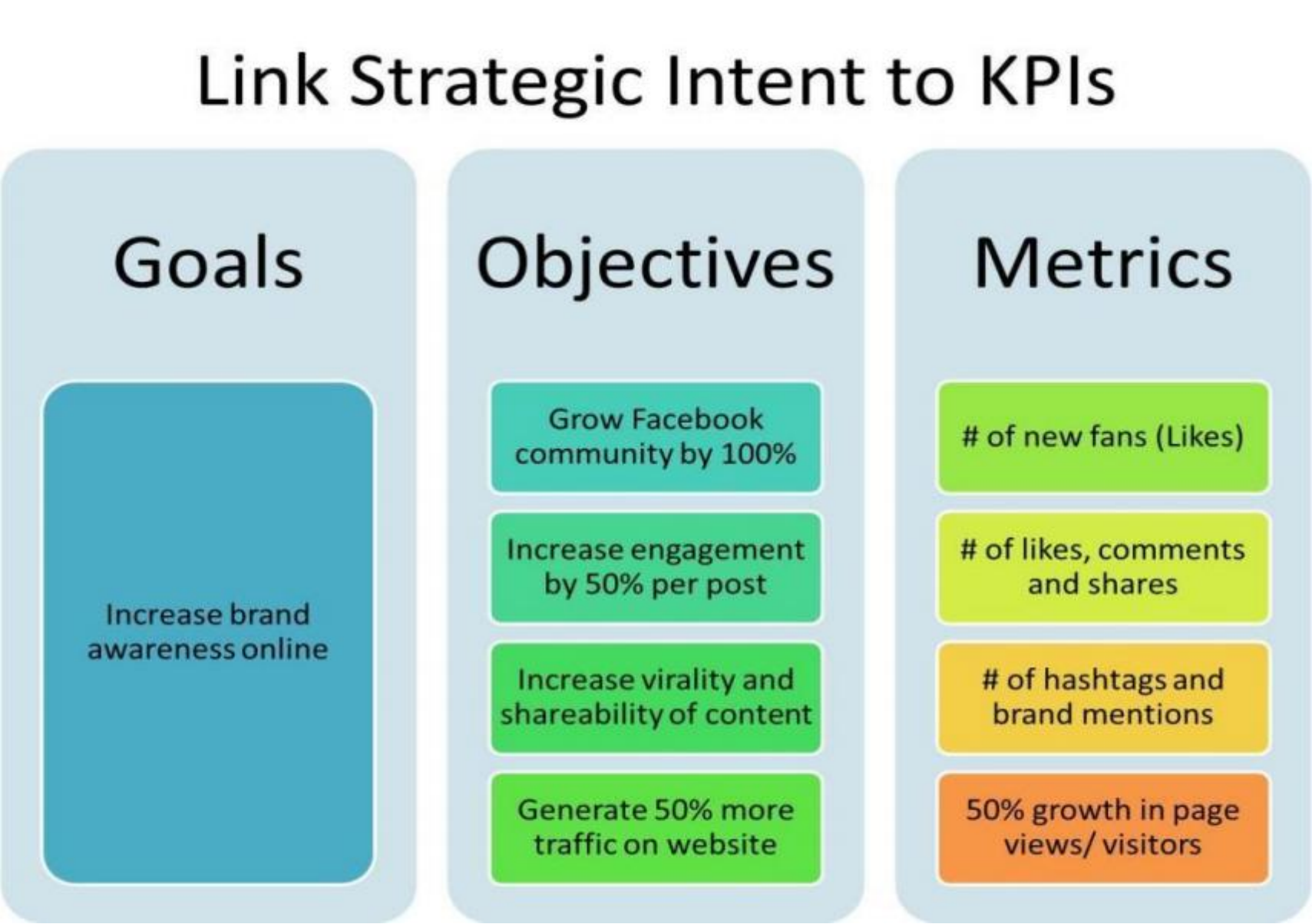
Key Performance Indicators (KPIs): the metrics that are tied to objectives.
In order for the KPIs to be valuable, the objectives they are supposed to measure need to be well-defined.
Counting and Metrics
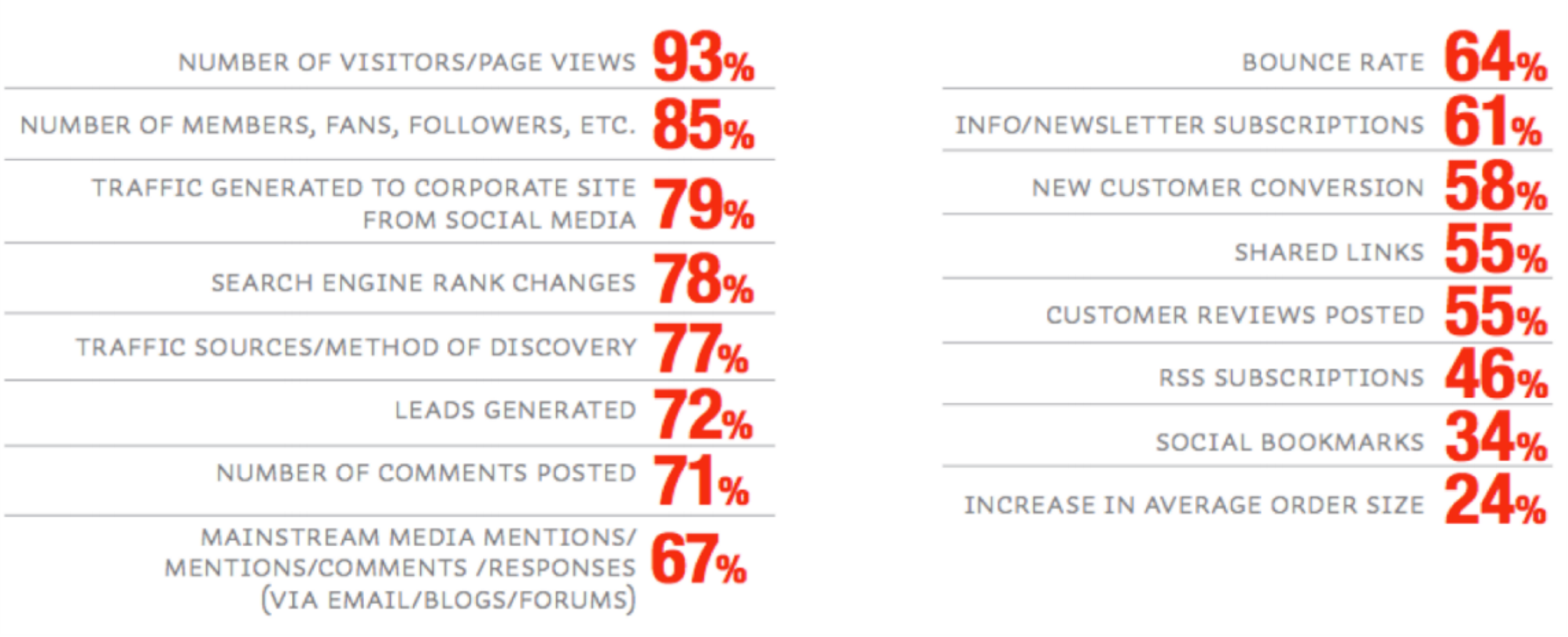
When marketers want to demonstrate the value of the activities, they often turn to:
- counting
- Impressions
- Visitors
- Friends
- Posts
- Players
The most commonly used metric is the number of impressions per social media content.
Use of:
- Brand sentiment
- Influence
- Viral spread
- Buzz
...are often underutilised.
Strategic Options for Social Media Measurement Model
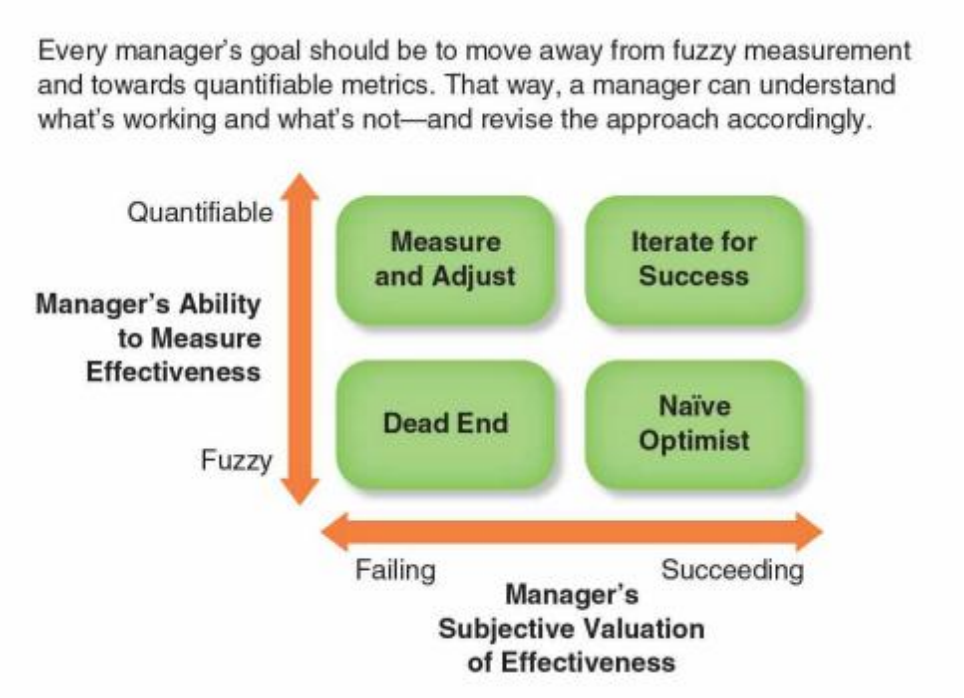
Using the Strategic Options for Social Media Measurement Model, marketers may more effectively use social media metrics.
Social media marketers may see social media as:
- Dead end: fuzzy measures, ineffective
- Needs adjustment: quantified measures, ineffective strategies
- Naively optimistic: fuzzy measures, effective strategies
- Iterative process: quantified measures, effective strategies
What Can Be Measured?
Some key metrics include:
- Reach: The number of people exposed to a message.
- Frequency: The average number of times someone is exposed to a message.
- Site stickiness: The ability of a site to draw repeat visits and keep people on the site.
- Relative pull: A comparison of how well different creative executions generate a response.
- Clickthroughs: Number of people who actually click on content.
- Sales conversions: Number of people who click through and then purchase.
- Viewthroughs: People who view but don’t click, yet visit the brand site later.
Mapping KPIs to the Customer Journey
Counting the quantity of interactions between consumers and brands, on its own, does not give valuable information.
“Four thousand two hundred and thirty-one is a measurement. Without context, it is merely a number.
When compared with your personal best, company expectations, or your competitors’ efforts, that number becomes a metric.
It is now indicative of value, importance or a change in results.”
By understanding the stages of the customer journey, the KPIs that are relevant for each stage can be identified.
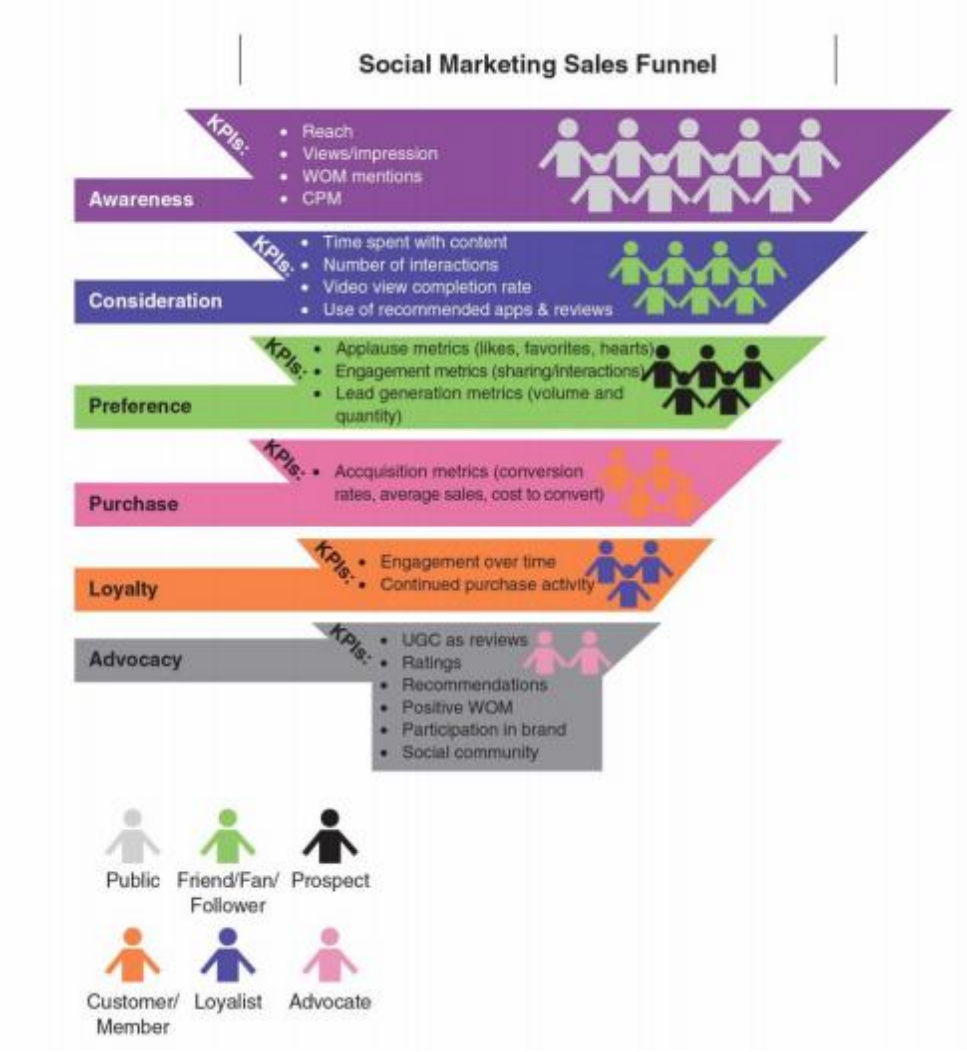
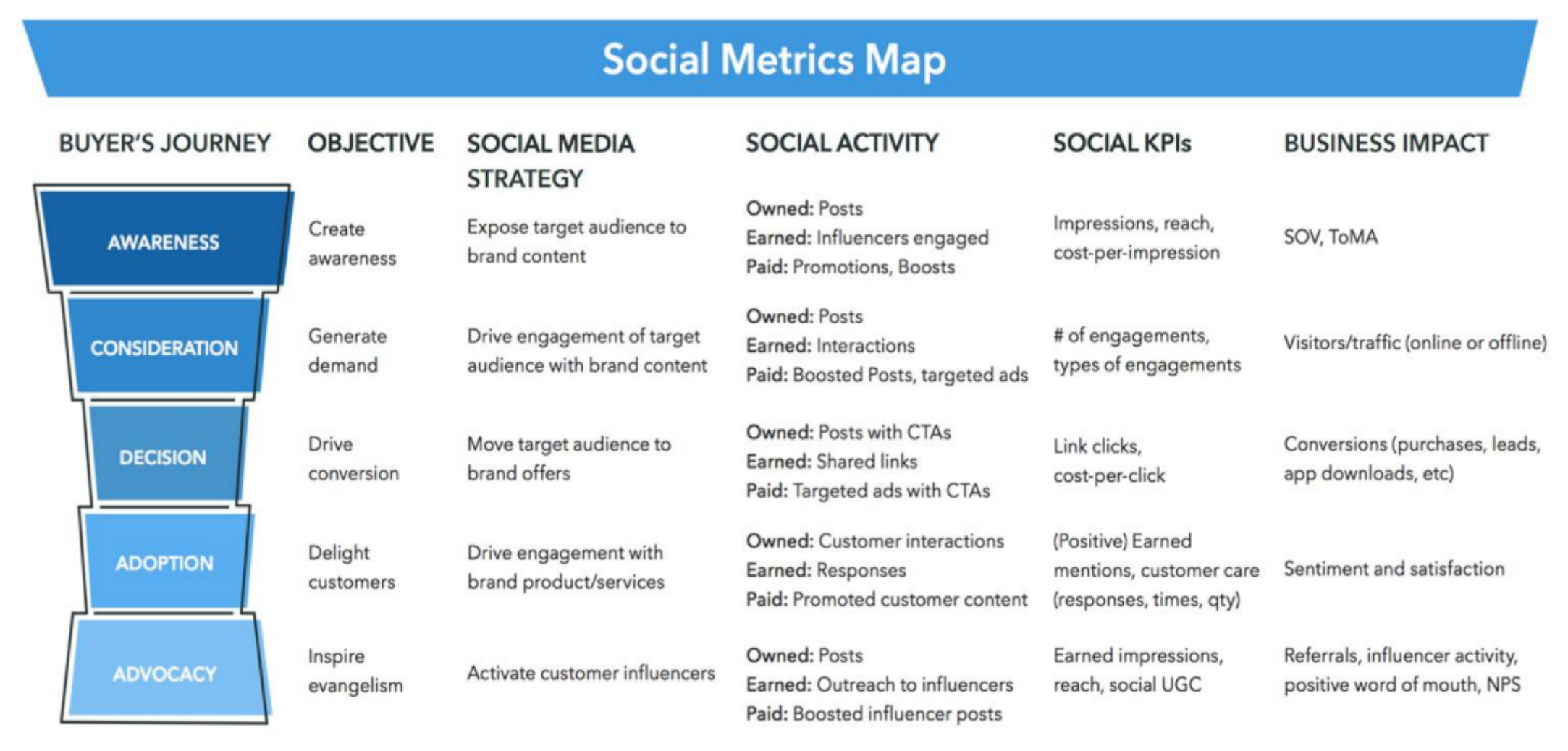
Social Media Metrics, KPIs and the Customer Journey
What constitutes as metrics?
- Measurements within a defined context are metrics
- Measurements require context to provide useful feedback
- Metrics that are tied to objectives are key performance indicators (KPIs)
- Objectives must be well defined before KPIs can be properly identified
Evaluation and Measurement: The DATA Approach
Social media strategy can be organised with the four-step process known as the DATA approach:
- Define: Define the results that the program is designed to promote
- Assess: Assess the costs of the program and the potential value of the results
- Track: Track the actual results and link those results to the program
- Adjust: Adjust the program based on results to optimise future outcomes
Step One: Define
The first step involves defining the objectives and what needs to be measured.
Common overarching objectives include:
- Motivating some behavior from the target audience (e.g. website visits, product purchases)
- Influencing brand knowledge and attitudes (especially among sharers/influencers)
- Achieving the above objectives more efficiently than with other methods
Why is Social Media ROI Important?
- Justify the time and money spent on social media marketing
- Change perception of social media across the organisation
- Secure additional budget
- Expand future social media marketing initiatives
- Understand what is working and what is not
Measuring Social Media ROI: Definitions
- Social media share of voice: The percentage of brand mentions, or people talking about a company online compared to its competitors.
- Top of mind awareness: When a company, brand or product is first in customers'minds when thinking of a particular industry/category.
- Earned media: The most valuable type of media, as it increases brand awareness with no additional effort on the part of the in-house marketer(s).
- Net promoter score (NPS): A metric that companies use to measure the willingness of customers to recommend a company's products or services to others.
Measuring ROI with Google Analytics
Set up custom social media goals within Google Analytics dashboard:
👉 Google Analytics Goal Setup Guide
ROI Metrics in Google Analytics
- Social media traffic: Shows how much many website visits are generated from social media.
- Network referrals: Shows all of the website visits from each social media website. It can help marketers see which social networks are driving the most web traffic
- Data hub activity: Shows how people are talking about and engaging with your website on social media.
- Landing pages:Shows which website pages get shared the most on social media.
More GA ROI Tools
- UTM Campaign results: Track how many visits each unique URL or social media post drove to your website from the UTM parameters as well as what happened to these visitors once they landed (how long they stayed, if they made a purchase).
- Conversions: Show the total number of conversions or revenue from each social media network.
- Plugins: Show which social media share buttons are being clicks on from your website, and which content is shared the most using these buttons.
- User flows: Show the path that users took from social media to get to your website. You can see which page they entered on, and where they continued to other parts of your website.
The Social Media ROI Pyramid
The Social Media ROI Pyramid explains
- how objectives vary at each business level,
- how executives at those levels use social media metrics,and
- the types of metrics that are most appropriate.
This framework captures necessary insights to guide business priorities and resource allocations across the organisation, marketing strategy decisions, and other decisions about social media tactics. 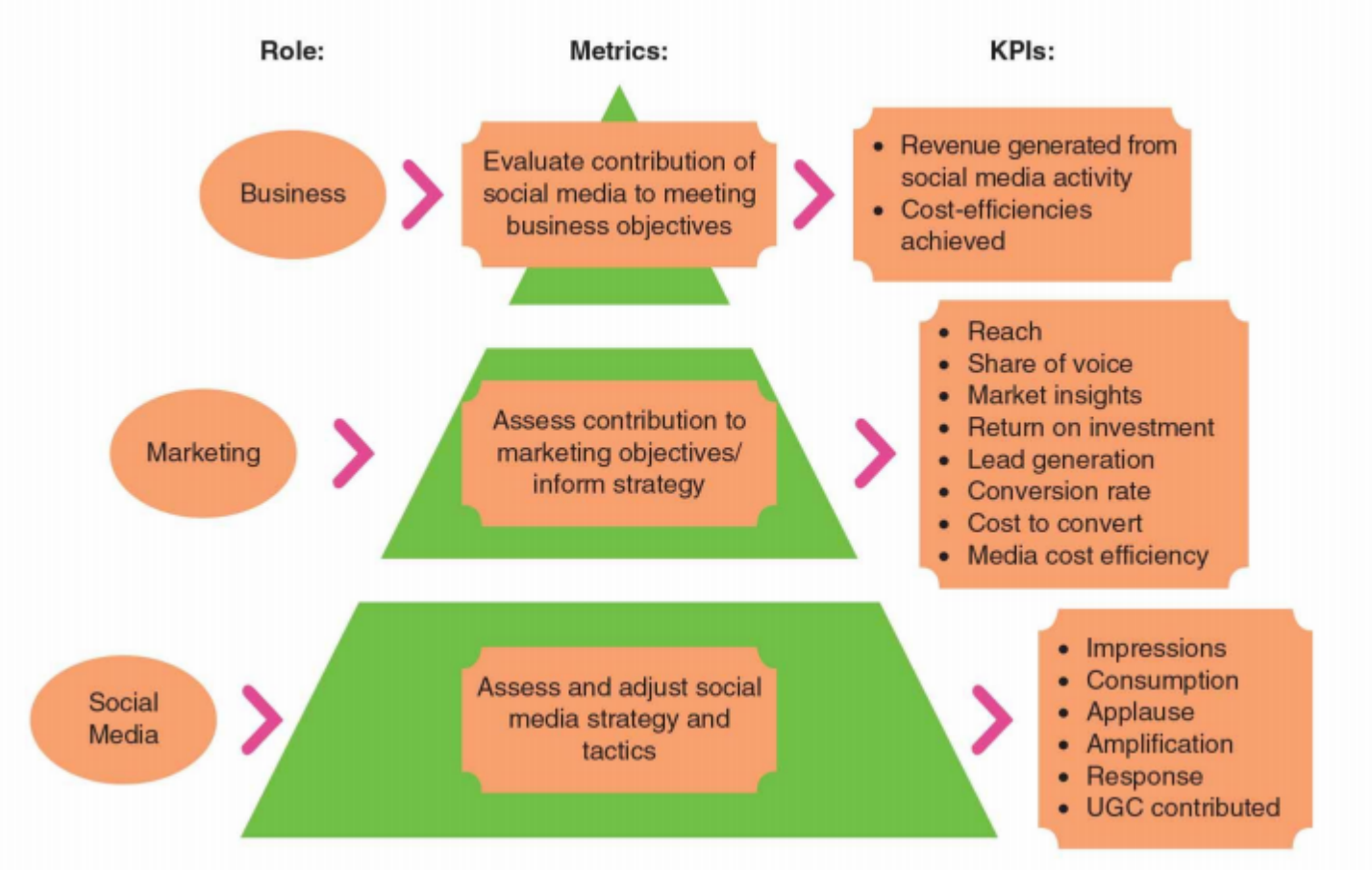
Define SMART Objectives
SMART = Specific, Measurable, Achievable, Relevant, Time-based
This is NOT a SMART objective:
“We will tell everyone we can about our new Facebook page and see if they like it so much they’ll buy more of our product.”
Defining objectives in a specific manner is not as easy as it sounds.
Even the most desirable outcomes (e.g. brand engagement, cost-efficiency) must be clearly defined to be useful in assessment.
Generating Awareness
Metrics that will tell the size and growth rate of a social media audience, how well that audience appears to know a brand, and how positively that audience feels about a brand.
- Numbers of mentions, impressions, views of brand-related content on video platforms, people following on social networking sites, etc.
Generating Consumer Engagement
Metrics that relate to the level of engagement and interaction consumers have with your brand on social media, including brand-related consumer-to- consumer interactions.
- Numbers of “likes,” (and other platform-related reactions), clicks, comments, reviews, pre-conversions, etc.
Generating Positive Attitudes
Metrics that reflect the increase in positive attitudes toward a brand
- Approval actions for posts, absolute sentiment (positive overall brand mentions), relative sentiment (increase in share of positive overall brand mentions and decrease in share of negative overall brand mentions)
Generating Advocacy
Metrics that tell the extent to which customers help in gaining more customers via various social interactions
- Increase in number of positive testimonials, product rankings, referrals, etc.; net promoter score
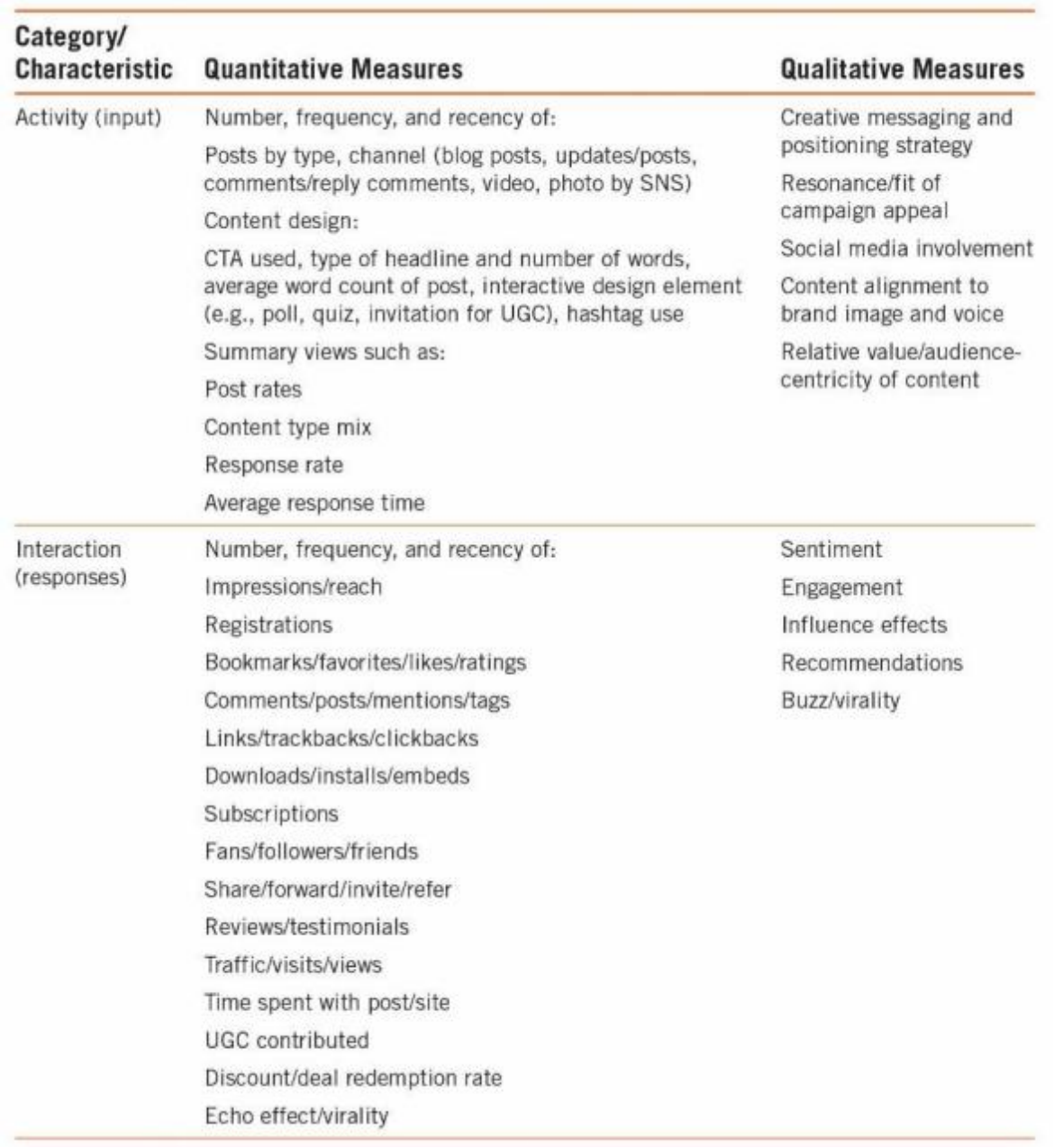
Elements of the Social Media Marketing Metrics Matrix
Three categories of metrics:
- Activity Metrics – Organisation's social media marketing efforts
- Interaction Metrics – Target marketengagement with social media marketing
- Return Metrics – Outcomes achieved from social media activities and engagement
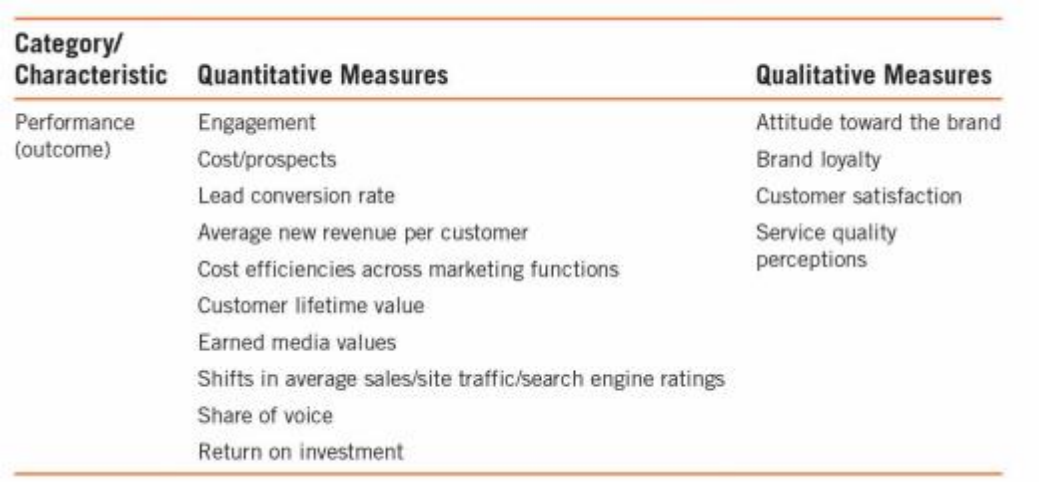
Return Metrics for Social Media
There are several ways to estimate the financial benefits of social media (social media ROI). Some common approaches include:
- Return on impressions: Demonstrates how many media impressions were generated by the social media tactics employed; the “opportunity to see”
- Return on social media impact: Track coverage across media and in different markets against sales over time; using advanced multiple regression analysis to analyse variables that may affect sales.
- Return on target influence: Uses survey data to assess the effectiveness of social media marketing.
- Return on earned media: Using Advertising Equivalency Value (AEV) to equate publicity in news media outlets to its paid advertising equivalent.
Note: Revise your campaign objective, as needed, and propose metrics to measure (Ensure that the ‘story’ of the document is consistent)
Step Two: Assess
The second step in the process involves assessing the value generated from social media activities and gathering feedback to use when making adjustments to strategies and tactics. This is directly linked to the Social Media ROI Pyramid.
Assessment will include financial assessments (e.g. return on investment models, cost efficiency estimates, and performance indicators) for each strategic and tactical design element in the social media marketing plan.
Potential Assessments
- A/B testing: An experiment in which two versions of a message, version A and version B, are tested against each other; controlling for all other variables, including audience targeting.
- Cost efficiency: A calculation that enables marketers to compare the cost of different tactics (e.g. impressions/traffic/fans generated).
- Opportunity cost: Explores what else the employees or volunteers could have done if they weren’t spending time on the brand’s social media activity.
- Service quality: An assessment that determines how well the brand addressed customer needs using social media relative to other customer care methods. Message/crisis control: An assessment of the influence of negative communications and crises using KPIs to gauge the success of risk mitigation efforts.
A/B Testing Example: Facebook Call-to-Action Buttons
Top CTAs tested:
- Learn More
- Sign Up
- Shop Now
- Download
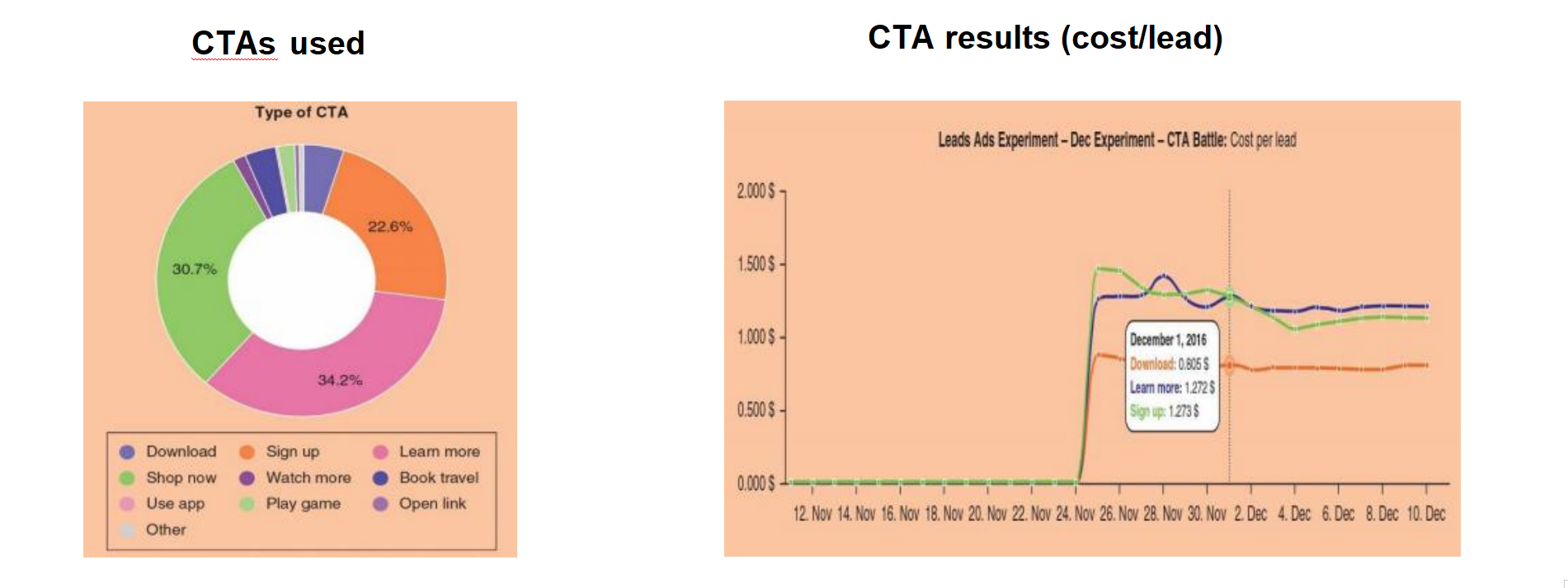
Measured by cost per lead.
Step Three: Track
During the tracking stage, data is collected and analysed by:
- Identifying - tracking mechanisms
- Establishing - baseline comparisons
- Creating - activity timelines
- Developing - transaction data
- Measuring - transaction precursors
- Overlaying - timelines to look for patterns
Data Sources for Tracking
Four key data sources in the social media ecosystem:
- Owned-site analytics (e.g. Google Analytics)
- SNS profile analytics (e.g. Facebook Insights)
- Social listening platforms (e.g. Brandwatch)
- Niche/API tools (e.g. Keyhole)
Approaches to Tracking
There are three main approaches:
- Forward tracking: Developed prior to launching the activity or campaign.
- Coincident tracking: Begins during the activity or campaign.
- Reverse tracking: Conducted after an activity or campaign has concluded
Given the volume of data, the multiple social channels to track, tactics, and numerous metrics, social media analytics (and tracking) is often facilitated by the use of a social media performance dashboard.
https://buffer.com/library/social-media-analytics-tools/
For Reflection: Marketers Struggle to Track “Dark Social”
When people share using text apps rather than directly from social media channels, tracking isn’t possible.
- 84% of social shares are relayed using dark social.
- 32% of those who share online content
will only share using dark social channels.
Dark social sharing is highest for entertainment, careers, and travel content.
Case study: Tourism Ireland’s Social Media Measurement
Social Equivalent Advertising Value (SEAV) valued different engagement indicators using cost per (mille) thousand (CPM) and cost per click (CPC).
- Post impressions: views of brand posts
- Page impressions: views of a brand page
- Personal response: clicks to view brand content
- Public response: liking, commenting, and/or sharing content
Equivalents used to estimate costs; SEAV calculated for each indicator. Results – SEAV calculation for social media campaign showed a financial return value of more than $2 million! www.tourismirelandindustryopportunities.com/how-we-can-help/social-media
Baselines
Baseline: a metric (often expressed visually) that allows a marketer to compare its performance on some dimension to other things, such as how competitors are doing or how its own efforts fluctuate over time.
Useful for:
- Comparing performance to competitors for the same timeline
- Comparisons between the brand's baseline performance and that of the industry social media performance.
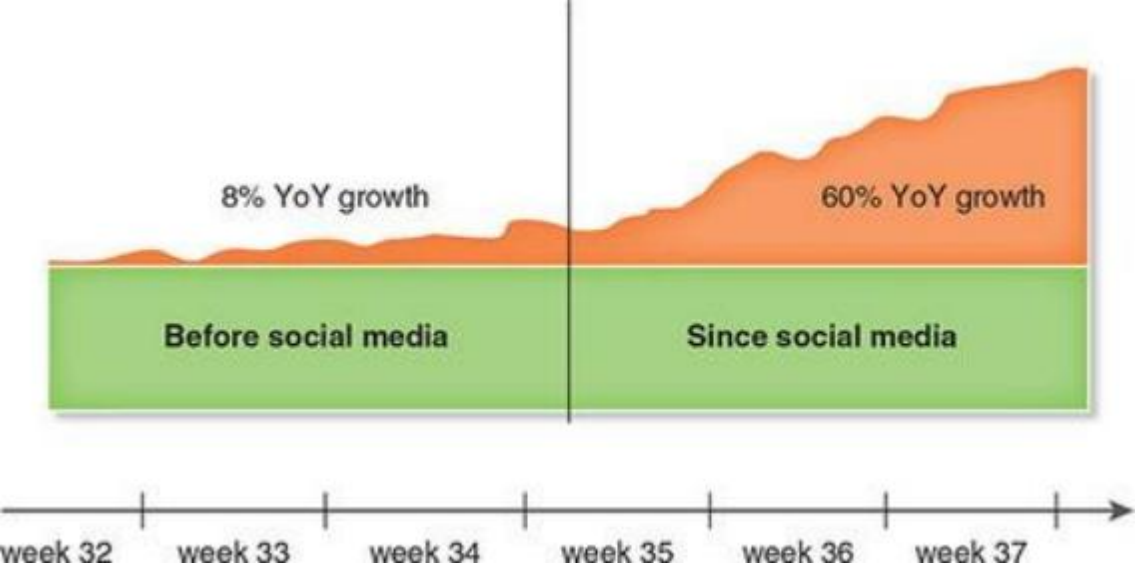 YoY = Year over Year
Step Four: Adjust
- In the final stage, the learnings are applied to future activities and investments.
- In this stage, the focus is on revising, realigning, and basing future decisions on the analyses
Simple Ways to Start Measuring
Here are key content-related metrics you can start with:
- Content consumption: who is interacting with and consuming the brand-enerated and consumer-generated content? Is it who you want to consume your content?
- Content augmentation: who is adding to or changing your content by continuing the conversation with response posts? In what ways is the content augmented? Is it consistent with what you want from the campaign?
- Content sharing: at what rate are those exposed to the brand messages sharing the content with others using share tools? Does the rate of sharing suggest campaign momentum?
- Content loyalty: how many consumers have subscribed to branded content with RSS feeds or by registering for site access?
- Content conversations: who is discussing the brand? Who is linking to brand websites? What is the comment-to-post ratio?
- Content engagement: is the number of friends to brand profiles growing? Are people contributing content like comments and photos?