Part A: Tactical Planning and Execution
Theory and Knowledge Development
Tactical Planning
There are several practical steps required for tactical planning; including determining the right channels, content to deliver the desired experience, rules of engagement, and schedule.
- Why: Value-Drive Social Media Marketing
- Who: Understanding and Honoring the Target Audience
- Where: The Channel Plan
- What: Designing the Experience
- How: Producing and Scheduling Content Posting and Promotion
Why: Value-Driven Social Media Marketing
Social media tactics: The actions taken to execute the social media strategy.
The tactics guide the brand’s activities within the zones of social media in a way that fits with the social media strategy and objectives.
Strategic objectives and strategies are mapped onto tactical objectives and tactics.
Mapping Objectives for Strategies and Tactics
Example Table:
| Strategic Objective | Strategy | Tactical Objective | Tactics |
|---|---|---|---|
| Create brand awareness | Expose target audience to brand | Build brand presence in social communities Post interesting and interactive messages Engage in conversations with fans and influencers Promote links to high-value content | Develop brand profiles in selected SNS (e.g.,Facebook, LinkedIn, etc.) Post daily in each network Respond to comments and questions daily Use influencer list to target conversations around campaigns |
| Strategic Objective | Strategy | Tactical Objective | Tactics |
|---|---|---|---|
| Build brand image and reputation | Communicate brand image Encourage word-of-mouth communication | Develop robust content that reinforces brand messages while being of value to target audience Publish content on owned media channels and rich media experiences in social communities | Create, produce, distribute, and post content following content calendar Include interactive elements in all content as well as links to owned media content and share tools Retain influencers to seed priority content |
| Strategic Objective | Strategy | Tactical Objective | Tactics |
|---|---|---|---|
| Differentiate brand from competition | Provide experiences that illustrate differential advantages | Create and publish content that demonstrates value Invite reviews and ratings from happy customers as credible evidence of value | Create content for blog that highlights points of differentiation Develop recommendation widget Host reviews and ratings on- site and optimise for mobile search Use email marketing to request reviews 10 days after purchase |
| Strategic Objective | Strategy | Tactical Objective | Tactics |
|---|---|---|---|
| Generate demand/acquire customers | Create desire and deliver | Monitor social channels for prospective leads Seed influencers for persuasion and amplification Use group deals and crowdsourced lists to drive sales | Keyword monitoring generates alert for follow-up from sales team Influencer initiatives focused on specific sales goals Periodic flash sales announced on SNS |
| Strategic Objective | Strategy | Tactical Objective | Tactics |
|---|---|---|---|
| Retain customers/ build loyalty | Engage, delight,inspire, thank, and reward customers | Cluster fans and loyal customers to create brand community Build fan relationships Collaborate and co-create Reward reviews and ratings and other WOM communications Listen and monitor Respond to questions and comments | Invite UGC tied to each campaign and SNS Thank contributors publicly and reinforce fan behaviour by sharing and favoriting UGC content Positive WOM triggers delivery of coupon or other reward to fan Monitor brand mentions and respond to thank, solve problem, or alert internal teams to potential crises |
Who: Understanding and Honouring the Target Audience
Target audience research is a key component of the strategic process. It provides the insights needed to develop the experience strategy to engage the target audiences in the zones of social media.
It is important to engage the target audience as social media is about participating, sharing, collaborating and co-creating; the culture of social media.
The Persona Template
The persona is the character description that highlights key information about the target audience.
For you, this should focus specifically on the key information that guides social media tactics.
Where: The Channel Plan
- Who uses this channel, what are they using it for, and how much time do they spend here?
- What are conversations like here? What kinds of content work best here?
- Will participation in this channel help us meet our objectives? Does it make sense for our business to use this channel?
- What specific goals can be pursued here given the channel’s functionality? Do these goals relate to objectives in our strategic plan?
- Can we establish a unique presence and make a valuable contribution to the community? Does our brand image, voice, and tone fit with the channel culture?
- Are our competitors present here? If so, how are they performing?
- If we participate in this channel, what will we contribute? What will we ask fans and followers to do when they engage with us and after engagements? Share? Comment?
- Does the channel offer paid media options to ensure audience reach and the ability to target specific audience segments?
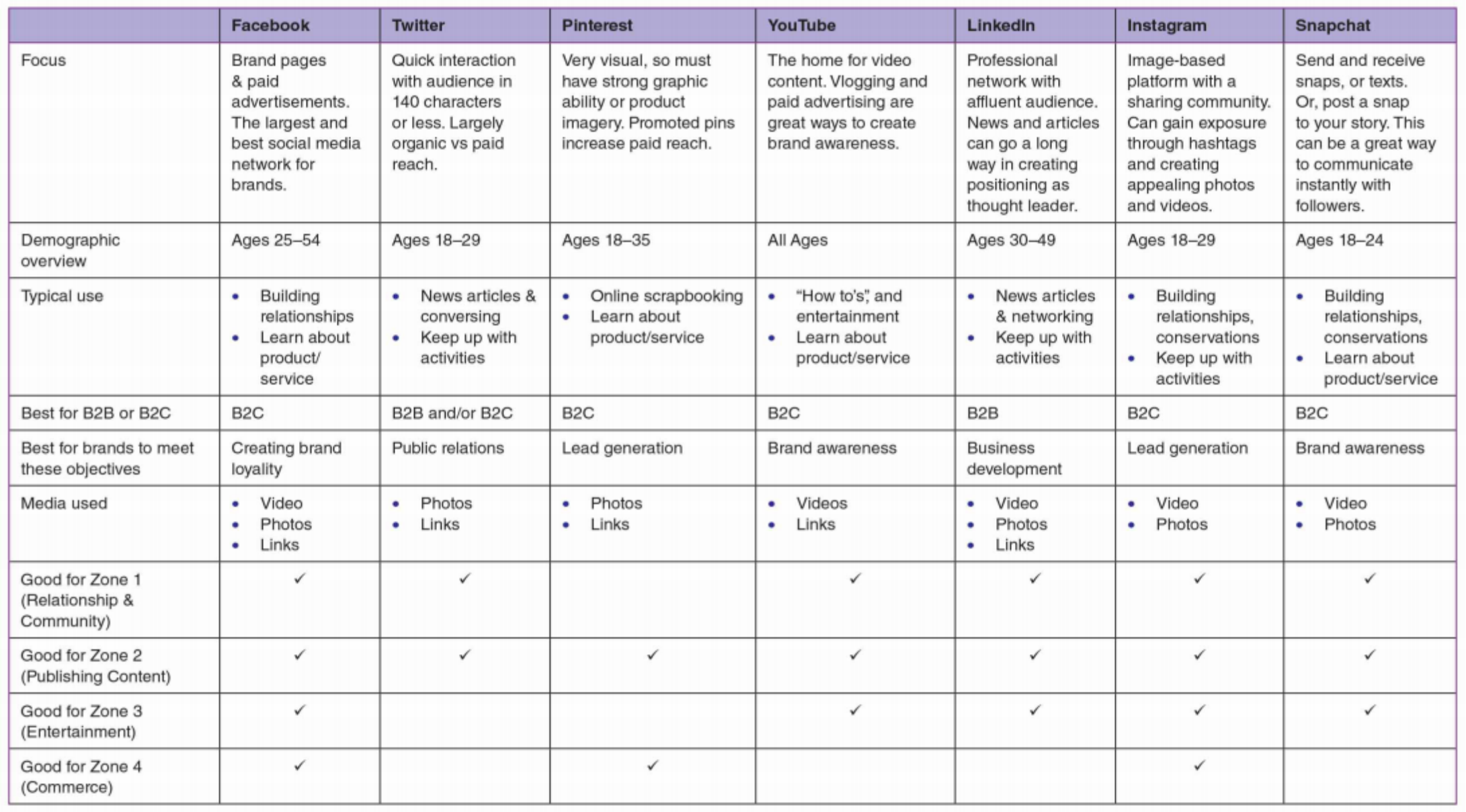
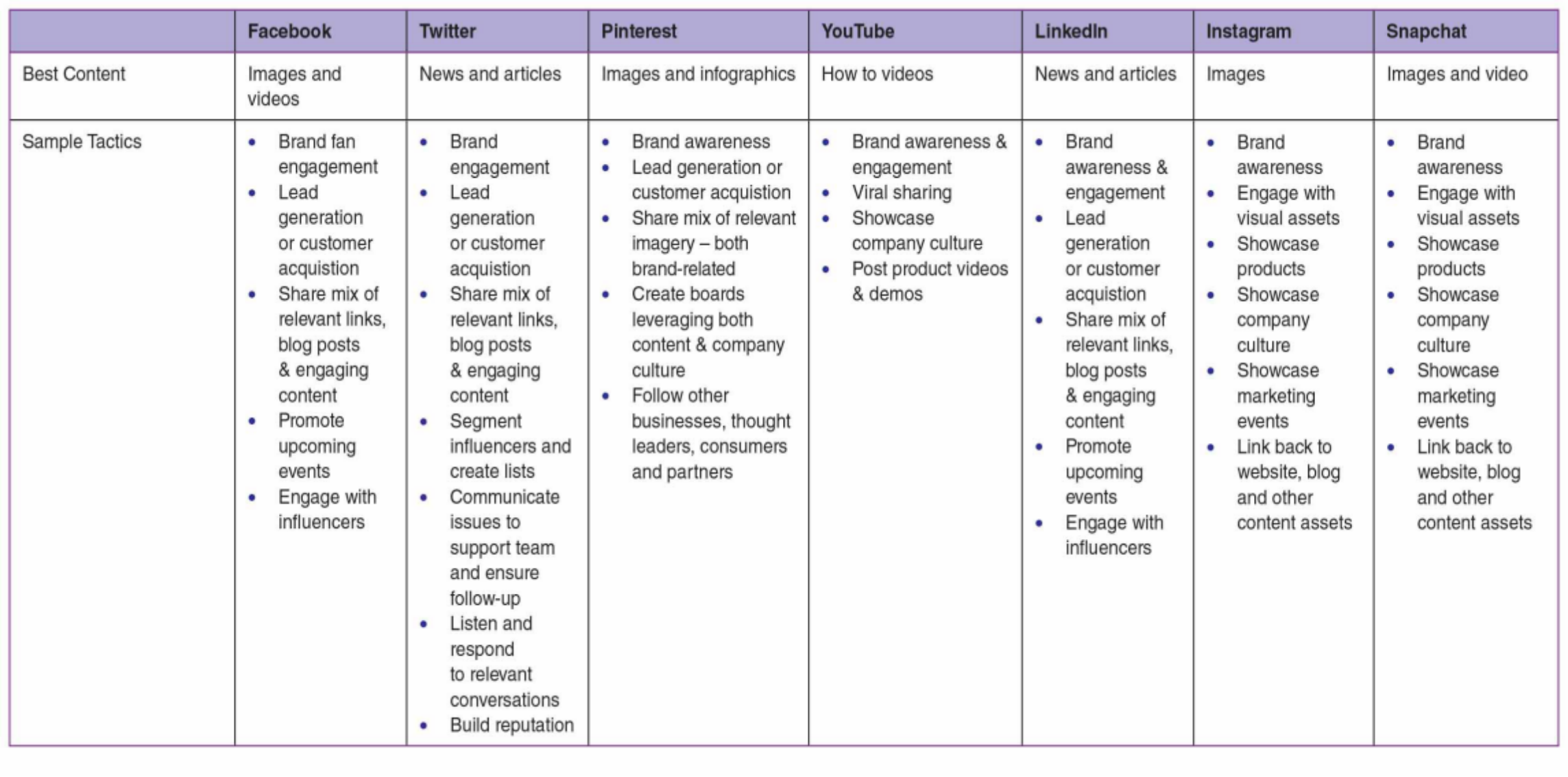
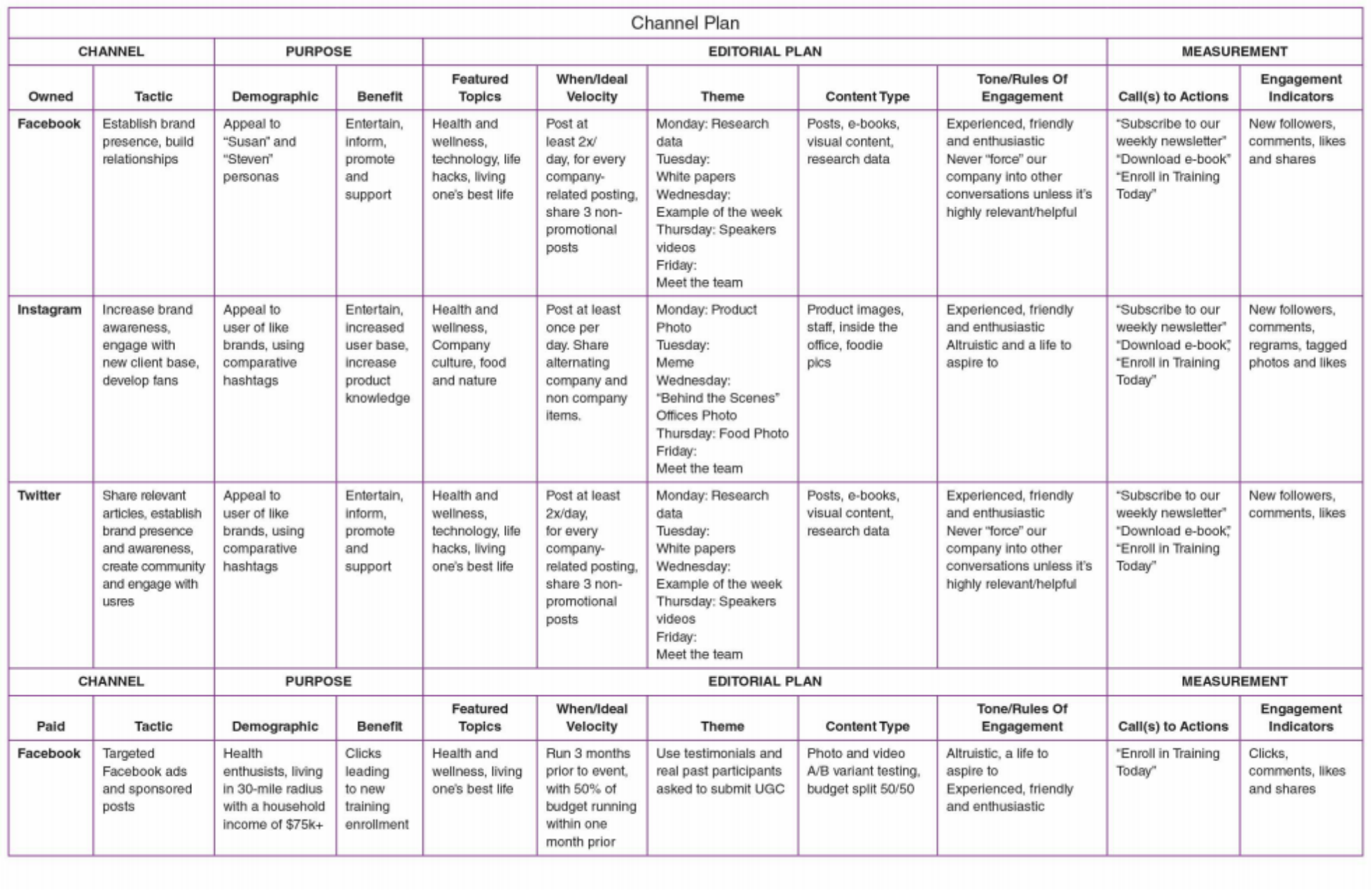
Social Media Advertising: Cost, benefits, and tips 2024: https://blog.hootsuite.com/social-media-advertising/
What: Elements of Social Media Experience
The design of the experience encompasses three main elements (including themes, topics, appeals, source and style):
- Type of tactic
- Content type
- Content strategy
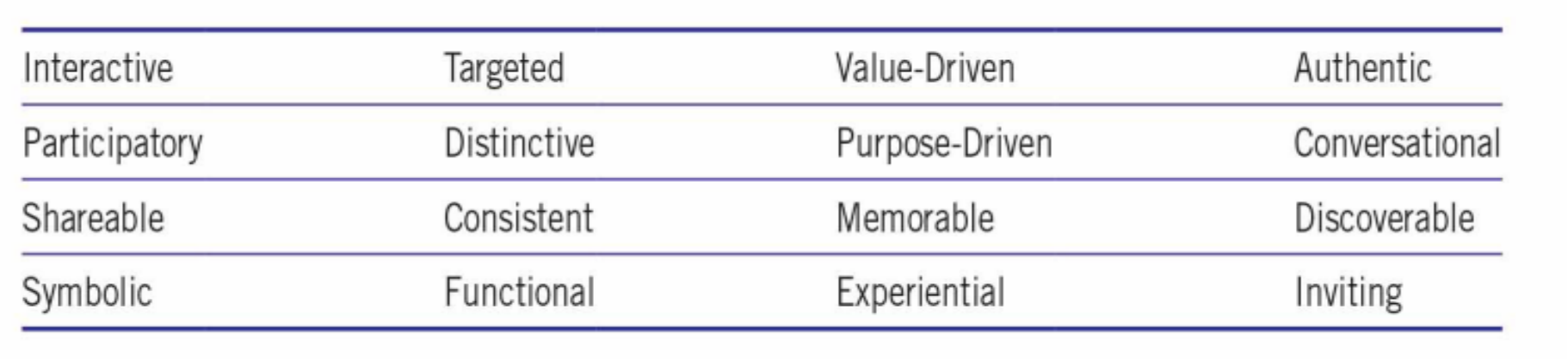 Characteristics of Effective Social Media Tactics
Social Media Marketing Tactics
| Tactic | Zone | Description |
|---|---|---|
| Branching | 1 | Complementing offline brand presence with a presence in social network sites (e.g., brand profile aligned to brand elements) |
| Contributing | All | Contributing in a valuable and meaningful way; investing in the community |
| Friending | 1 | Participating in relational activities with other members of the social community (e.g., conversations, interactions, shared activities) |
| Informing/Broadcasting | All | Posting one-way messages about brand and/or its offer (product, price, promotions), possibly linking to e-commerce site |
| Clustering | All | Building communities around shared interest (i.e., social object) whether as an embedded social community (e.g., GoPro Facebook fan page), owned branded community (e.g., MyStarbucksIdea), or brand-sponsored |
| Listening/Monitoring | All | Monitoring social media, assessing and responding, collecting data for market research purposes |
| Collaborating | All | Cooperating, partnering, and/or co-creating (i.e., interdependent contributors) |
| Crowdsourcing | All | Enlisting the efforts of many individuals to acquire resources to accomplish a task (i.e., many independent contributors) |
| Seeding/Propagating | All | Increasing social word-of-mouth communication by triggering viral network effects with influencers |
| Educating | 2 | Teaching, explaining, and/or coaching others |
| Entertaining | Providing socially enabled entertainment and/or participating in social activities in which the social object is entertainment | |
| Gamifying | 3 | Associating the brand with a game or gamifying exposure to the brand message |
| Incentivising | 3, 4 | Offering a reward in exchange for social engagement (e.g., giving gamers credits if they view an in-game ad) |
| Selling | 4 | Facilitating sales with social apps and widgets, conducting transactions within SNS, supporting purchase decisions with social word-of-mouth communications |
| Serving | 1 | Providing customer service on social network channels |
Content Marketing Matrix
Content type: An information asset whose attributes distinguish it from all other kinds of content. Considerations of which types of content:
- Are typical for the sites
- Fit the tactic’s strategic intent
- Are most popular among the target audience
- Are best for relaying brand messages
- Are feasible given the staffing, creative, monetary, and temporal resources of the brand.
Using the content marketing matrix, content is plotted based on whether it is emotional or rational, and whether the target audience is passive or active.
Evaluation of Content Types for Social Media Marketing
| Content type | Suitable for Objective | Participatory(P) /Shareable(S) | Publish to Channels | Promote on Channels | Desired Action | Cost/ Difficulty |
|---|---|---|---|---|---|---|
| Images | Brand awareness, engagement, lead generation, customer acquisition | P + S | Instagram, Facebook, Twitter, Pinterest | Instagram, Facebook, Twitter, Pinterest | Comments, likes, shares | Low |
| Pre-recoded video (ODV) | Brand awareness, engagement, point of differentiation | P + S | Instagram, Facebook, Twitter, Blog, YouTube | Instagram, Facebook, Twitter,Pinterest, Blog, YouTube | Views, comments, likes, shares | High |
| Pre-recoded video (repurposed) | Brand awareness, lead generation, customer acquisition, engagement | S | Facebook, Instagram, YouTube | Instagram, Facebook, YouTube, Twitter, Snapchat, Blog | Views, comments, likes, shares | Low |
| Blog post | Brand awareness, engagement, event promos, influencer promos, brand equity | S | Blog, Facebook, Twitter, LinkedIn, Instagram, Pinterest | Facebook, Twitter, LinkedIn, Instagram, Pinterest, Snapchat | Views, inquiries, comments, likes, shares | Low-Moderate |
| Infographic | Brand awareness, lead generation, customer acquisition, engagement | P + S | Blog, Instagram, Facebook, Twitter, Pinterest | Instagram, Facebook, Twitter, Pinterest, Embed | Comments, likes, shares | Moderate |
| Article page | Brand awareness, engagement, event promos, influencer promos, brand equity | S | Facebook, Instagram, Twitter | Facebook, Instagram, Twitter | Comments, likes, shares | Moderate |
| Case study | Brand awareness, engagement, event promos, influencer promos, brand equity | P | Blog, Facebook, Twitter, Instagram, Pinterest | Blog, Facebook, Twitter, LinkedIn, Instagram, Pinterest, Snapchat | Views, inquiries, comments, likes, shares | Moderate |
| Annual report | Brand awareness, engagement, lead generation, customer acquisition influencer engagement, brand equity | P | Blog, Facebook, Twitter, LinkedIn, Instagram, Pinterest | Blog, Facebook, Twitter, LinkedIn, Instagram, Pinterest, Snapchat | Views, inquiries, comments, likes, shares | High |
Content Strategy: Discovery Process
- Is the target audience actively seeking information about your brand? Is their attitude toward the brand positive? What content or information do they need? Can you help solve a “pain point” in their jobs or lives? What can you offer them that they would care about?
- What differentiating value can your brand bring? What can you develop that is truly different from and more valuable than that of the competition?
- What could we develop that will be synergistic with the brand’s overall marketing efforts?
- What do we need to say? What will the target audience be receptive to?
- What content types will be used? Can the content be developed as a series to increase impact?
- Where will the content be published and distributed?
- What resources do you have already or can you acquire to develop content?
Content Strategy: Point of View (POV)
It is recommended that the content mix should follow an 80–20 formula; 80% of the content is audience-focused and 20% brand-focused. In other words, for every four social media posts that are audience-centric, the brand can share one post that is brand-centric or sales-oriented.
- Hygiene content: The constant foundation; serving as the brand’s active presence in each social community and includes archived content that is “evergreen.” Evergreen content: the information is likely to remain useful and reliable over a long period of time.
- Hub content: Less frequent but of greater value to the target audience and more likely to generate interest and engagement.
- Hero content: Truly buzz-worthy content.
A Sample Content Strategy Framework
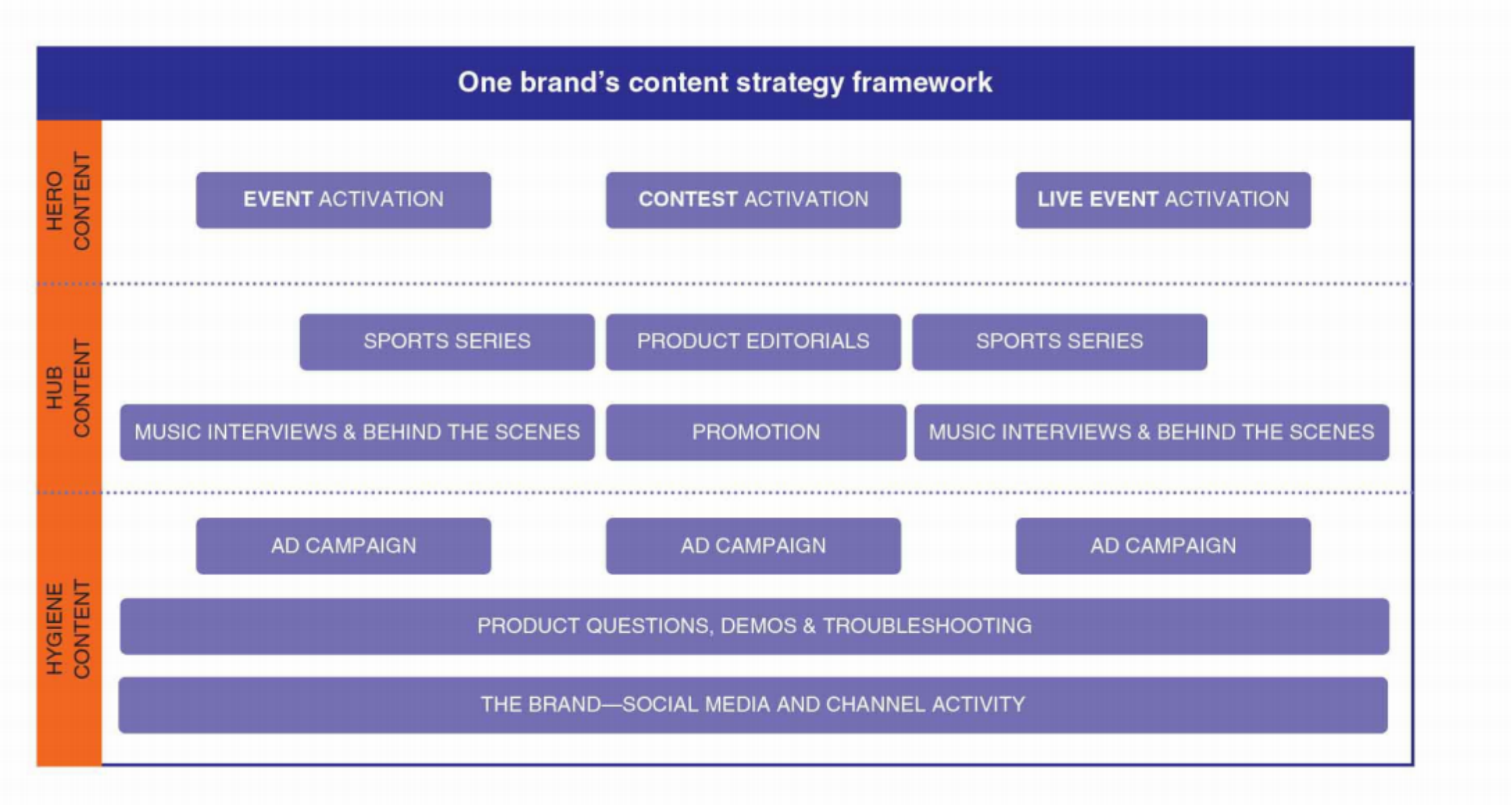
A Content Strategy Document Example
- Tactical Approach: Most content will align with the primary tactics of educating and contributing and secondary tactics of friending and serving; minimal content will broadcast information about our products, pricing, and special offers (80/20).
- Type: Because our brand offers a high-involvement, high-risk service, credible and detailed information is valuable for preparing the audience to choose a service provider. Videos and articles published on our company blog will be the primary content types. These will be promoted with short, conversational posts in our chosen social channels.
- Content Theme: Content themes will include 1) brand slogan; 2) empowering decision makers for risky decisions; 3) stressful decisions.
- Content Topics: Videos will relay the stories of customers told in the form of a dramatization. The story arc will engage the viewer in an emotional and well-crafted drama that ultimately delivers a testimonial for ourservice. The videos will be constructed as a series with one episode for every type of situation faced by our clients. These will be supported by a downloadable how-to guide that explains how prospective customers facing similar situations can choose a solution to meet their needs.
- Style: The brand’s persona is that of trusted advisor. The brand’s voice will reflect a personality that is empathetic, reassuring, reliable, and strong.
- Implementation Standards: All content with have a consistent voice, tone, heading, nomenclature, and editorial style. All content will include a call to action, a link to the company website, and the brand logo.
Tracking Competitors and Measuring Success
- Competitors can provide valuable insights for keyword research and other strategic decisions; monitoring if competitors are using certain channels or tactics and how these are received in the market.
- Analytics can help those using social media marketing to determine the success of their strategies.
What is a Social Media Workflow?
A social media workflow: A sequence of connected steps that enables the organisation to act efficiently with minimal overlapping tasks and resources in order to implement the social media marketing plan effectively.
Workflows help teams:
- Understand the vision behind tasks
- Assign responsibilities
- Complete projects requiring different skills
- Prioritise time and resources
Common Mistakes
- Posting from the wrong account
- Mishandling responses when replying to comments
- Creating content that offends the target audience
- Posting content without checking it first
- Promoting the competition,
- Sharing too much information
- Auto-tweeting without monitoring for current events
- Co-opting a trending topic for reach
- Responding to trolls
A Day In The Life Of A Social Media Manager
For reflection
- 86% of adults experience social media stress!
- Stress is highest among “constant checkers.”
- For social media marketers, the “always- on” nature of social media equates to major stress at work.
Digital Detox?